
Summary
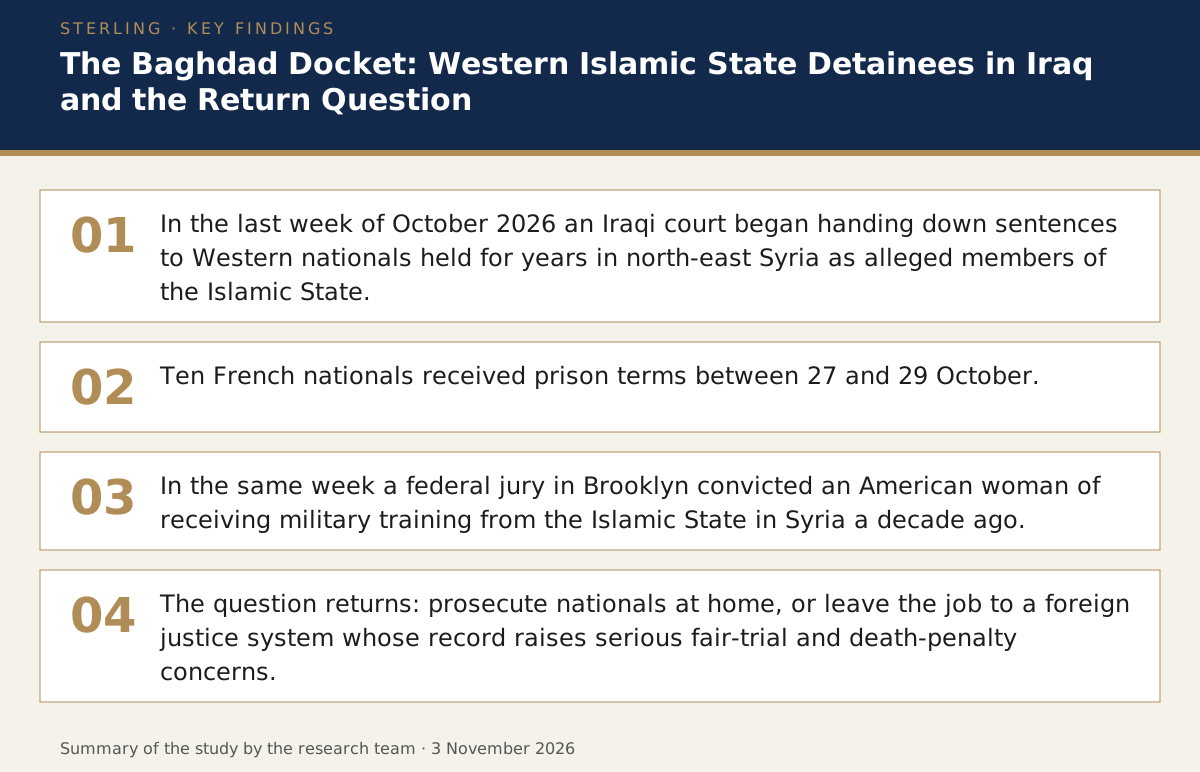
In the last week of October 2026 an Iraqi court began handing down sentences to Western nationals who were held for years in north-east Syria as alleged members of the Islamic State and then moved to Iraq. Ten French nationals received prison terms between 27 and 29 October. In the same week a federal jury in Brooklyn convicted an American woman of receiving military training from the Islamic State in Syria a decade ago. Together these developments bring back a question that Western governments have put off since 2019: whether to prosecute their nationals at home, or leave the job to a foreign justice system whose record raises serious fair-trial and death-penalty concerns. This paper sets out what is known, what is not, and the policy choices that follow.
1. How the detainees came to be in Iraq
According to Human Rights Watch, the United States military transferred 5,704 men and boys held as alleged Islamic State members from north-east Syria to Iraq between 21 January and 12 February 2026. This followed clashes between the Syrian Democratic Forces and advancing Syrian transitional government troops (Human Rights Watch 2026). According to Iraq's Supreme Judicial Council, as reported by Human Rights Watch, the detainees come from 67 countries, 19 of them in the European Union. In February the Supreme Judicial Council had given a count of 61 nationalities (Rudaw 2026). Human Rights Watch's provisional list includes Australia, Canada, France, Germany, the United Kingdom and the United States. More than 440 of those transferred are children (Human Rights Watch 2026). France 24 reported at the time that the first group of 150 transferred detainees included Europeans, and that Iraq's prime minister urged European Union countries to repatriate their nationals (France 24 2026).
Separately, 47 French nationals had been handed over to Iraq from north-east Syria in 2025 (Supreme Judicial Council 2026; Human Rights Watch 2026). Their cases are the first Western ones to reach verdict.
2. The October verdicts
On 27 October 2026 the Al-Karkh Criminal Court in Baghdad sentenced six French nationals to life imprisonment and a seventh to 15 years for membership of the Islamic State (Associated Press 2026; DW 2026). On 29 October the same court gave life sentences to three more, in the presence of their lawyers and representatives of the French Embassy. The court acted under Iraq's Anti-Terrorism Law No. 13 of 2005 (Supreme Judicial Council 2026). Under Iraqi law a life sentence amounts to 20 years, (DW 2026; Mahmoud 2026), and the sentences are subject to automatic review by the Court of Cassation (Mahmoud 2026). Rudaw quoted a diplomatic source at the French Ministry for Europe and Foreign Affairs as saying that the penalties were provided for under Iraqi criminal law, and that the defendants had access to the evidence, interpreters and counsel. The source noted that French lawyers must work alongside a lawyer admitted to the Iraqi Bar (Rudaw 2026).
These verdicts were custodial, not capital. Human Rights Watch notes, however, that the charges carry the death penalty. It reports that Iraq has made informal, but not official, agreements with some countries to waive it (Human Rights Watch 2026). Reporting from the courtroom quoted the presiding judge telling a defendant that the charge "carries the death penalty" but that he had chosen to give him "a chance to reform" (Mahmoud 2026).
3. The due-process problem
Human Rights Watch says that the detainees arrived without case files or identity papers. It says that five foreign detainees alleged torture during interrogation in 2026, and that 13 of the French men transferred in 2025 made similar allegations through their lawyer. Iraqi authorities deny any mistreatment, and Human Rights Watch says it could not confirm the allegations (Human Rights Watch 2026). The organisation also reports that some court-appointed lawyers represent up to 250 detainees each. It questions whether Iraq has jurisdiction over foreigners who may never have been in Iraq (Human Rights Watch 2026).
For European governments this matters because, as Human Rights Watch notes, European Convention on Human Rights case law prohibits states parties from sending individuals to countries where they might face the death penalty or flagrantly unfair trials (Human Rights Watch 2026). Even where states have not transferred anyone themselves, relying on foreign prosecutions brings legal and reputational risk.
4. Repatriation has stalled
Iraq has asked countries to repatriate foreigners it does not convict of crimes linked to Iraq, and the United States has also called for repatriations. By early October 2026, Human Rights Watch reported, only two transferred detainees were known to have been repatriated, both children: one boy to Finland and one to a North African country (Human Rights Watch 2026). A Western source cited by Human Rights Watch says that the United Kingdom has provided about £400,000 in aid to detain, care for, investigate and prosecute the detainees. That figure comes from a single unnamed source. We found no UK government source for it and have not confirmed it independently.
Before the transfers, repatriation from the Syrian camps had been uneven. Citing Rights & Security International data from September 2025, Eunews reported that 11 European Union member states had repatriated almost 1,000 citizens, mostly minors and women, and that France alone accounted for about 600 (Eunews 2026). In February 2026 the European Parliament called on member states to repatriate their citizens, especially children, and to bring adults to justice in fair trials (Eunews 2026).
5. Western courts can prosecute legacy cases
October 2026 also showed that domestic prosecution of legacy cases is workable. On 27 October a federal jury in the Eastern District of New York convicted Halima Salman, aged 27, of receiving military-type training from the Islamic State in Syria in late 2016 or early 2017. The evidence included a training certificate and images recovered from her husband's battlefield phone. The Department of Justice's Office of International Affairs helped obtain evidence overseas (United States Department of Justice 2026). In Germany, the Federal Prosecutor General had officers of the Bundeskriminalamt (Federal Criminal Police Office) arrest two Kuwaiti-born men: Nuri A. on 30 September and Gharib S. on 1 October. Both are suspected of serving with the Islamic State in Iraq in 2016–2017 (Generalbundesanwalt 2026a; 2026b). Separately, the Düsseldorf Prosecutor General's office has charged a 30-year-old Iraqi national living in Essen before the Higher Regional Court in Düsseldorf with Islamic State membership between April and September 2016. The indictment was filed on 4 September and announced on 29 September. He is not in custody, and the court has yet to decide whether to admit the charge (Generalstaatsanwaltschaft Düsseldorf 2026). The German cases are allegations and have not been tested in court.
Battlefield evidence, international evidence-sharing and patient investigation can sustain convictions years after the event. That weakens the argument that repatriated adults cannot be prosecuted.
6. Why this matters for the threat at home
The Director General of MI5 said on 13 October 2026 that "Al Qaida and Islamic State continue to direct and inspire attacks" (McCallum 2026). Detainees left indefinitely in overcrowded foreign prisons are a risk in their own right. Human Rights Watch reports that Al-Karkh prison is at 158 per cent of capacity, and notes that its predecessor facility, Camp Cropper, had reportedly become a recruitment centre for armed Islamist groups by 2007 (Human Rights Watch 2026). A prisoner released by Iraq after a 20-year sentence, or after acquittal, and not managed by their home state is a less controlled risk than a returnee who has been prosecuted and placed under supervision at home.
7. Policy options
- Case-by-case managed return of adults for domestic prosecution, where the evidence supports charges. This follows the model of the Salman prosecution and the German legacy arrests.
- Priority return of children and young men detained since childhood, with safeguarding assessment, in line with the European Parliament's call of February 2026.
- If Iraqi prosecution continues, formal written assurances on the death penalty and consular trial monitoring, rather than informal understandings.
- Sharing evidence with Iraq only where safeguards are in place, and continuing to build domestic case files, including for nationals who may eventually be released.
- Post-release planning for nationals convicted in Iraq, covering supervision, deradicalisation and information-sharing on release dates.
Gaps and caveats
We have not identified official figures for British, German or other non-French Western nationals now held in Iraq. We have not confirmed the outcome of the automatic cassation review of the French sentences, the number of further French trials scheduled, or the death-penalty assurances given to any state. Accounts of when in 2025 the 47 French nationals were transferred differ between sources, so we give only the year. The torture allegations reported by Human Rights Watch have not been verified.
References
Associated Press. 2026. "Iraq Sentences 7 French Nationals over IS Membership." 27 October. https://apnews.com/article/iraq-french-citizens-islamic-state-sentenced-6753948311cf47f6ea70657f90db3059
DW. 2026. "Iraq: Life Sentences for 3 French 'Islamic State' Suspects." 29 October. https://www.dw.com/en/iraq-life-sentences-for-3-french-islamic-state-suspects/a-79802390
Eunews. 2026. "Strasbourg Calls on Member States to Repatriate Their Citizens Detained in ISIS Camps in Syria." 12 February. https://www.eunews.it/en/2026/02/12/strasbourg-calls-on-member-states-to-repatriate-their-citizens-detained-in-isis-camps-in-syria/
France 24. 2026. "Europeans among 150 IS Detainees Transferred from Syria to Iraq." 23 January. https://www.france24.com/en/live-news/20260123-volatile-security-blocks-un-from-syria-is-linked-camp
Generalbundesanwalt. 2026a. "Festnahme eines mutmaßlichen Mitglieds der ausländischen terroristischen Vereinigung 'Islamischer Staat (IS)'." Press release, 30 September. https://www.generalbundesanwalt.de/SharedDocs/Pressemitteilungen/DE/2026/Pressemitteilung-vom-30-09-2026-2.html
Generalbundesanwalt. 2026b. "Festnahme eines mutmaßlichen Mitglieds der ausländischen terroristischen Vereinigung 'Islamischer Staat (IS)'." Press release, 1 October. https://www.generalbundesanwalt.de/SharedDocs/Pressemitteilungen/DE/2026/Pressemitteilung-vom-01-10-2026-2.html
Generalstaatsanwaltschaft Düsseldorf. 2026. "Anklage wegen Mitgliedschaft in einer ausländischen terroristischen Vereinigung ('Islamischer Staat' – 'IS')." Justiz NRW, 29 September. https://www.justiz.nrw/presse/2026-09-29-2
Human Rights Watch. 2026. "Iraq: Dire Prospects for Alleged ISIS-Linked Men, Boys." 5 October. https://www.hrw.org/news/2026/10/05/iraq-dire-prospects-for-alleged-isis-linked-men-boys
Mahmoud, Sinan. 2026. "Iraqi Court Hands Life Sentences to Three More French ISIS Members." The National, 29 October. https://www.thenationalnews.com/news/mena/2026/10/29/iraqi-court-hands-life-sentences-to-three-more-french-isis-members/
McCallum, Ken. 2026. "MI5 Director General Delivers Annual Threat Update." MI5, 13 October. https://www.mi5.gov.uk/mi5-director-general-delivers-annual-threat-update
Rudaw. 2026. "Iraq Sentences Three French Nationals to Life Imprisonment over ISIS Membership." 29 October. https://www.rudaw.net/english/categories/iraq/1079941
Supreme Judicial Council (Iraq). 2026. "Al-Karkh Criminal Court: Life Imprisonment for 3 French Terrorists Affiliated with ISIS." 29 October. https://www.sjc.iq/view-en.80996/
United States Department of Justice. 2026. "American Woman Convicted of Receiving Military Training from ISIS in Syria." Office of Public Affairs, 27 October. https://www.justice.gov/opa/pr/american-woman-convicted-receiving-military-training-isis-syria