
Summary
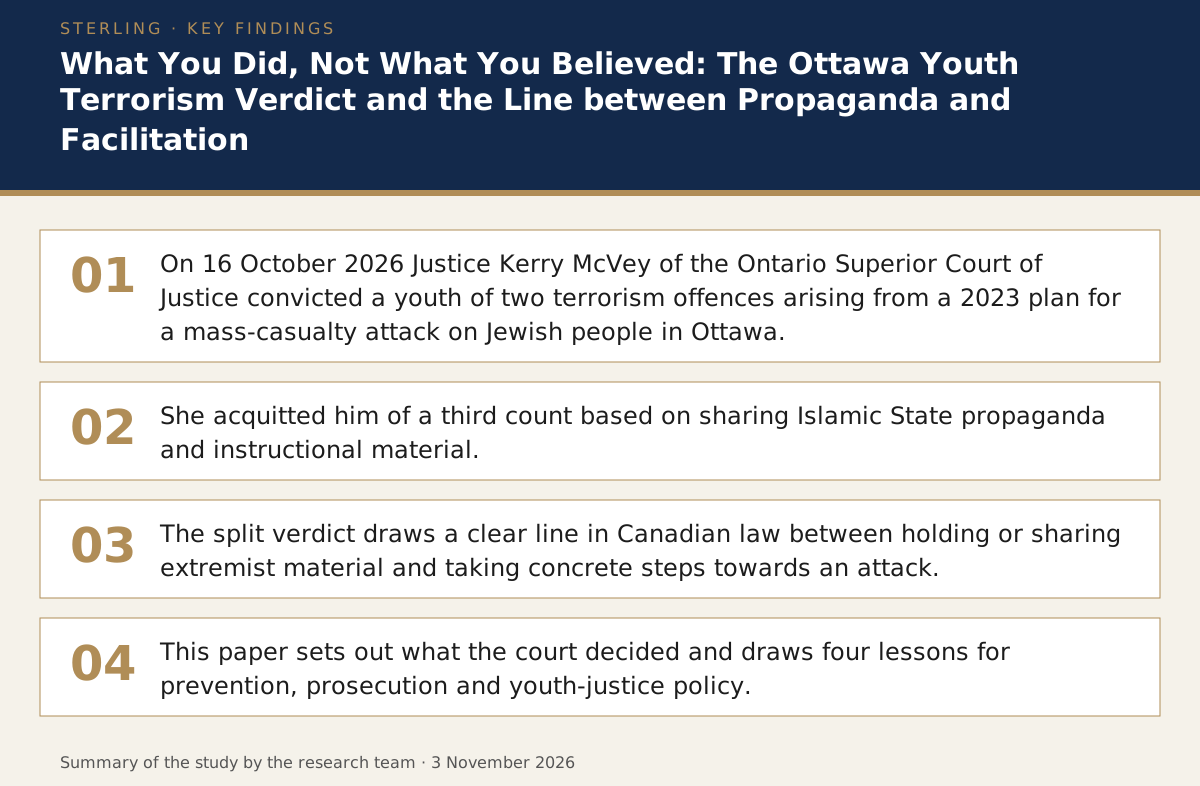
On 16 October 2026 Justice Kerry McVey of the Ontario Superior Court of Justice convicted a youth of two terrorism offences arising from a 2023 plan for a mass-casualty attack on Jewish people in Ottawa. She acquitted him of a third count based on sharing Islamic State propaganda and instructional material (Bronskill 2026; CBC News 2026; Radio-Canada 2026). The split verdict draws a clear line in Canadian law between holding or sharing extremist material and taking concrete steps towards an attack. This paper sets out what the court decided and draws four lessons for prevention, prosecution and youth-justice policy.
1. The facts as found
- The youth, who cannot be named under the Youth Criminal Justice Act, was 15 when he was arrested in February 2024 (CBC News 2026).
- The court found that he conspired with a co-accused and a third, uncharged person to carry out a mass-casualty attack intended "to intimidate a segment of the public, namely members of the Jewish community" (McVey J, quoted in Bronskill 2026).
- Guilty: conspiracy to commit murder for a terrorist group, and facilitating terrorist activity by seeking to acquire a prohibited firearm. The court found that he contacted possible sources of firearms, asked about availability and price, and passed the information back to his co-accused (Bronskill 2026; single source: Canadian Press copy only).
- Not guilty: facilitating terrorist activity by making instructional material and propaganda available. The material included Islamic State videos and documents on firearms, explosives and methods of killing. The judge was not satisfied beyond reasonable doubt that he knew he was furthering a terrorist activity when he sent it (Bronskill 2026; CBC News 2026).
- The judge told him: "You are not being found guilty because of what you believed. You are being found guilty because of what you did" (quoted in Bronskill 2026; single source: Canadian Press copy only).
- The Crown has said it will seek an adult sentence (CBC News 2026). No sentencing date has been reported.
- The co-accused admitted a statement of facts and invited a finding of guilt on four charges, a course that preserves his right to appeal pre-trial rulings (Bronskill 2026). He was found guilty in April 2026, and the trial of the youth convicted on 16 October began the following day (Bronskill 2026; CBC News 2026).
2. Why the acquittal matters
The acquittal shows that the facilitation offence in section 83.19 of the Criminal Code needs proof of knowledge or purpose linked to terrorist activity, not simply that the material was extreme. In the judge's words, "the issue before me is not whether the content was offensive, alarming, or extremist in nature" but whether it was sent "for the purpose of assisting a terrorist activity" (quoted in CBC News 2026; Radio-Canada 2026). The research team's analysis: this mens rea standard protects expression, and prosecutors should not expect the content of shared material alone to carry a facilitation charge.
3. Policy lessons
This section is the research team's analysis.
- Weapons-seeking is the decisive evidence. Conviction rested on steps towards acquiring firearms. Firearms-trafficking intelligence and online test purchases are therefore as important to youth terrorism cases as monitoring content.
- Propaganda-sharing calls for prevention, not prosecution. Where sharing alone is unlikely to support a terrorism charge, governments need well-resourced early-intervention routes that do not depend on the criminal law.
- Youth sentencing is the next test. The Crown's application for an adult sentence will show how Canadian courts weigh deterrence against rehabilitation for under-18s in terrorism cases. Officials should follow the reasons closely.
- Antisemitic targeting should be tracked as a distinct threat category. The court expressly found that the plan aimed to intimidate the Jewish community. Protective-security funding and threat assessments should reflect this.
4. What to watch
- The sentencing hearing and the ruling on the adult-sentence application.
- Any appeal by either youth.
- Whether the Public Prosecution Service of Canada or Ontario's Crown publishes guidance on charging decisions where only propaganda-sharing is involved.
References
Bronskill, Jim. 2026. "Youth Found Guilty of Terrorism Charges Tied to Alleged Plan to Kill Jewish People in Ottawa." The Canadian Press, via The Globe and Mail, 16 October. https://www.theglobeandmail.com/canada/article-youth-guilty-terrorism-charges-jewish-people-ottawa/.
CBC News. 2026. "2nd Youth Accused of Anti-Jewish Terror Plot Guilty of 2 of 3 Charges." 16 October. https://www.cbc.ca/news/canada/ottawa/ottawa-teen-jewish-terror-trial-decision-9.7383168.
Radio-Canada. 2026. [French-language report on the Ottawa youth terrorism verdict; headline not recorded]. ICI Radio-Canada, 16 October. https://ici.radio-canada.ca/nouvelle/2293318/terrorisme-adolescent-ottawa-accusation-proces.